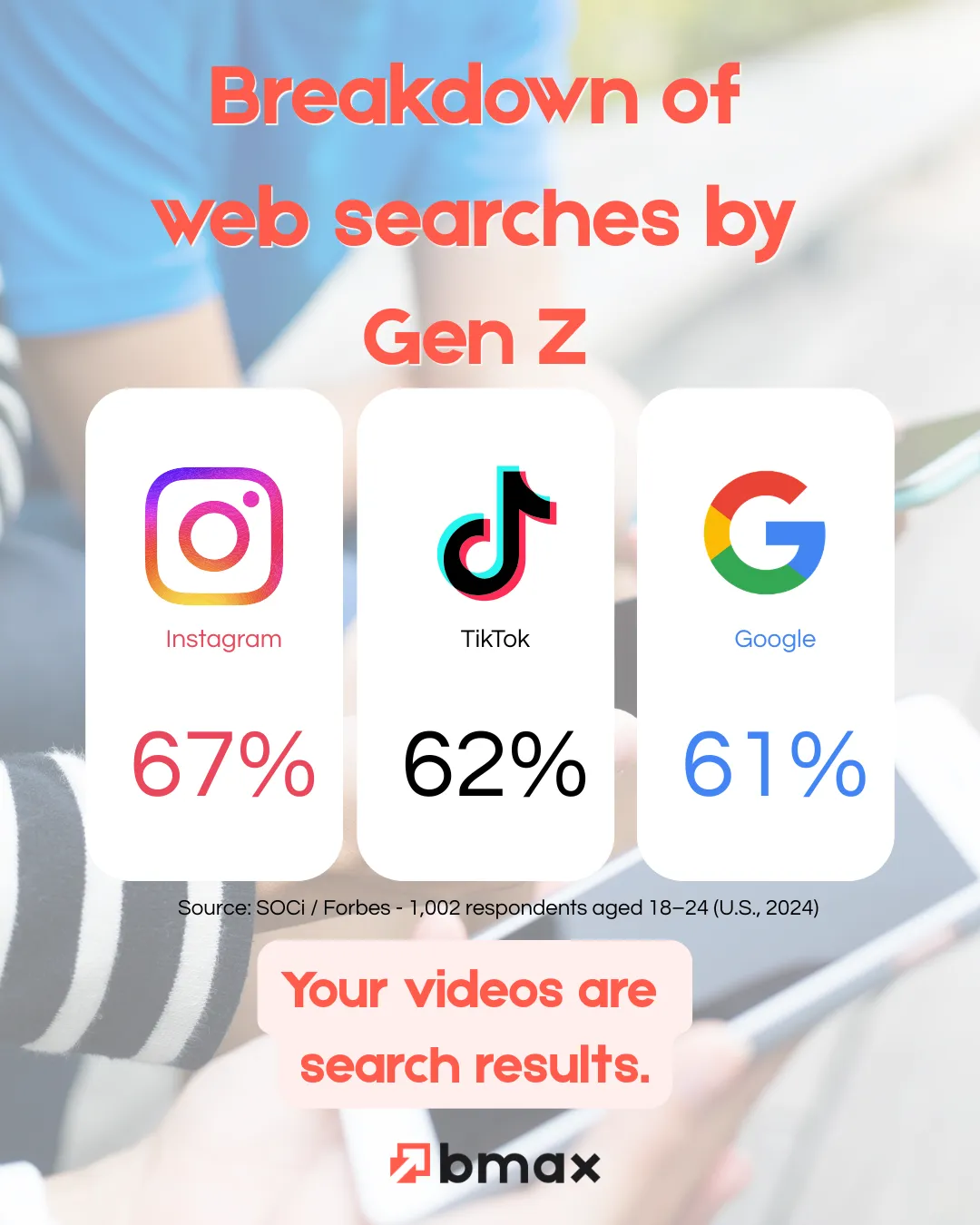
Gen Z local search behaviour : it has fundamentally shifted, with Instagram now surpassing Google for discovering nearby businesses. The way people look for a nearby shop, restaurant or service provider has shifted. For Generation Z, the first move is no longer always Google. According to the SOCi study (Consumer Behavior Index, March 2024, reported by Forbes, 1,002 respondents aged 18 to 24 in the U.S.), 67% of Gen Z uses Instagram for local search, 62% TikTok and 61% Google. Google is no longer first – it ranks third. For a local business, this does not mean dropping Google. It means understanding that visibility is now contested on several fronts at once.
In this article:
- What the numbers actually say
- Why Instagram and TikTok became search engines
- Every video you publish is a search result
- Are you visible on all three platforms?
- Has Google been abandoned, how to optimize, multi-platform: your questions
- Local search no longer lives on a single platform
- How to adapt your business to Gen Z local search habits
What the numbers actually say
67% of Gen Z searches local on Instagram, 62% on TikTok and 61% on Google, according to SOCi (2024). These figures add up to more than 100%: a single user checks several platforms for one search. This is not Google being replaced by social media, but a multi-platform behavior. The question is not “where does Gen Z search” but “are you present everywhere they look”.
| Platform | Gen Z share (local search) | Rank |
|---|---|---|
| 67% | 1 | |
| TikTok | 62% | 2 |
| 61% | 3 |
Source: SOCi Consumer Behavior Index, March 2024 (Forbes) – 1,002 respondents aged 18-24, U.S.
Why Instagram and TikTok became search engines
On Instagram and TikTok, users do not type a query to read ten blue links: they type a city name or a type of place and watch videos. “Restaurant Digne-les-Bains”, “hair salon near me”, “where to eat tonight” become visual searches. The result is not a web page, it is a video. If your business does not show up in those results, it does not exist for this audience, even if your website ranks perfectly on Google.
The underlying difference: on Google, people search for information. On Instagram and TikTok, they search for an experience, an atmosphere, social proof before going somewhere. Video answers a question text cannot: “what does it really look like”.
Every video you publish is a search result
This is the key point for a local business: a properly optimized video is a potential search result, exactly as a web page is for Google. Three levers make it findable. The title, written for search rather than for looks. The captions, indexable and read by the algorithm as much as by the user watching on mute. The description, rich in local keywords: city name, neighborhood, type of service.
A video with no search-driven title, no captions and no geolocated description is like a web page with no title tag and no text: invisible. The logic of search did not disappear with social search, it moved to video.
Are you visible on all three platforms?
The right question is not choosing between Google and social media, but checking your presence across the three channels Gen Z uses. In practice: an up-to-date Google listing, an active Instagram account with geolocated videos, and a TikTok presence built for local search. Three entry points, three times more chances to be found the moment someone decides where to go.
Has Google been abandoned, how to optimize, multi-platform: your questions
Has Gen Z really abandoned Google?
No. 61% of Gen Z still uses Google for local search according to SOCi (2024). The shift is not abandonment but expansion: Instagram (67%) and TikTok (62%) move ahead without making Google disappear. The behavior is multi-platform, not exclusive.
How do you optimize a video for local search?
Three elements: a title containing the keyword and the location, indexable on-screen captions, and a description rich in local keywords (city, neighborhood, type of service). These three levers turn a video into a findable search result on Instagram and TikTok.
Do you need to be present on all three platforms at once?
Ideally yes, because usage overlaps: the same user may check a place on Instagram then confirm on Google. Being absent from one channel means giving up part of the audience. A multi-platform presence maximizes the chance of being found at the right moment.
Local search no longer lives on a single platform
Local search is no longer limited to Google. For Gen Z, Instagram and TikTok have become full search engines, where each well-optimized video works like a search result. The challenge for a local business is not to bet on a single platform, but to be visible on all three, with content built to be found. The next step: audit your real presence on each channel and fix what makes you invisible.
Une version francaise de cet article est disponible :
Recherche locale Gen Z : Instagram passe devant Google
Want to know if your business is visible where your audience searches?
Let’s talk for 30 minutes –
BMAX supports local businesses on their digital communication.
How to adapt your business to Gen Z local search habits
Gen Z local search is reshaping which businesses get discovered. Without consistent, location-tagged Instagram content, you are invisible to a growing share of the local market. BMAX helps local businesses build an Instagram presence designed for the way Gen Z actually searches.