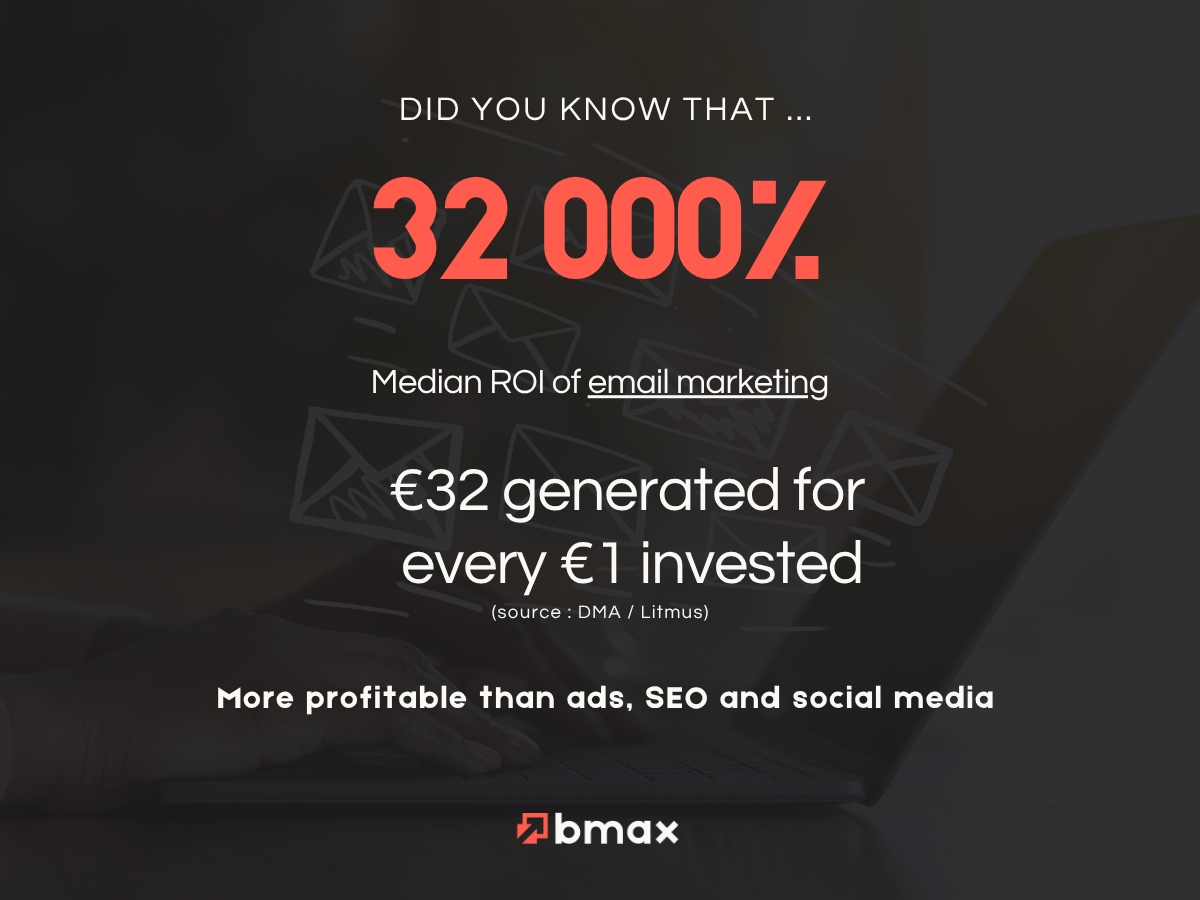
email marketing ROI in 2025 : it reached a median of 3200 percent making it the highest-performing digital channel bar none. The median email marketing ROI reached 3,200% in 2025, according to the annual DMA / Litmus study. In plain terms: every dollar invested generates $32 on average. No other digital channel comes close, not Google Ads, not SEO, not social media. Yet email remains the most underused channel for small and mid-sized businesses. This article breaks down why the gap exists, and the concrete levers to build a genuinely profitable email strategy.
In this article:
- 3,200%: where does this figure come from?
- Why email delivers such returns
- The three levers of a profitable email strategy
- Common mistakes that destroy ROI
- How to start concretely
- 3,200% ROI, yet still underused: the real takeaway
- Where the number comes from, sending frequency, tools: your questions
- Email marketing ROI benchmarks: what to aim for in 2025
3,200%: where does this figure come from?
The DMA / Litmus study measures annual email marketing ROI from thousands of responding businesses. The $32 return per dollar invested is a median, not an average. That distinction matters: the median reflects a “typical” company’s return, not the outliers that skew averages upward.
For comparison, Google Ads average ROI typically sits between 200% and 400% depending on the industry. Organic social media return is notoriously hard to attribute. SEO offers excellent long-term ROI, but with a 6 to 12 month delay before measurable returns kick in. Email marketing remains the only digital channel that combines high ROI and fast execution.
Why email delivers such returns
Four structural reasons drive this gap:
You own your list. Unlike Instagram, LinkedIn or Facebook, where algorithms decide who sees what, your email list belongs to you. If Meta changes its rules tomorrow, your Instagram followers can see their reach collapse overnight. Your email subscribers remain reachable.
The message arrives without intermediaries. No algorithm to please, no ad auction to win. Email lands directly in the recipient’s inbox. The only remaining filter is the subject line, where much of the success is won or lost.
Segmentation delivers the right message to the right person. A customer who already purchased doesn’t receive the same offer as a prospect who signed up yesterday. A visitor browsing pricing gets a different email than one who downloaded a whitepaper. Relevance mechanically lifts open, click and conversion rates.
Automation works while you sleep. Once scenarios are set up (welcome, cart recovery, anniversary, reactivation), they run continuously. It’s an asset generating value 24/7, with no human intervention.
The three levers of a profitable email strategy
1. A qualified list
500 engaged contacts outperform 5,000 inactive ones. Buying a database is the most expensive mistake: deliverability collapses (inboxes mark your emails as spam), and GDPR requires explicit consent that purchased lists never have. Build slowly with opt-in capture via website forms, downloadable lead magnets, or in-store collection.
2. A well-crafted subject line
35% of opens depend on the subject line. A few rules: under 50 characters so it displays fully on mobile, a clear promise (not vague teasing), personalization where possible (recipient’s first name or reference to past action), and zero spam triggers (“free”, “urgent”, “money”, multiple exclamation marks).
3. An automated sequence
The three highest-return automations, in priority order:
- The welcome email. First message after signup. Average open rate: 80%, versus 20% for a standard email. Recipient attention is at its peak.
- Cart abandonment recovery (e-commerce) or pricing page follow-up (services). Recovers 10 to 30% of lost opportunities.
- Inactive subscriber reactivation. A sequence sent to contacts who haven’t opened in 3 to 6 months, designed to bring them back or cleanly remove them from the list.
Common mistakes that destroy ROI
Sending the same message to everyone. Lack of segmentation is the leading cause of performance decay over time. Inactive contacts hurt overall deliverability, which hurts open rates, which hurts ROI.
Measuring the wrong indicator. Open rate has lost much of its meaning since Apple Mail Privacy Protection automatically loads images. Focus instead on click-through rate, conversion rate, and revenue per email sent.
Believing email is dead. Email competes with WhatsApp, push notifications, SMS and social media. It still posts the highest ROI precisely because it’s “older” and therefore more respected. The inbox remains a space where attention concentrates.
How to start concretely
Three steps are enough to launch a profitable email strategy in a small business:
Step 1: pick the right tool. For a small structure, Brevo (formerly Sendinblue), MailerLite or Mailchimp cover most needs. All offer free plans up to 500 or 1,000 contacts. Automation is included from the first paid tiers.
Step 2: build the first sequence. The welcome email. Three messages spaced 2 to 3 days apart: introducing the business, delivering value (a guide, a useful tip, a customer story), then proposing a first action (booking, trial purchase, quote request).
Step 3: measure and iterate. No complex dashboard needed. Three indicators are enough: click-through rate (content relevance), conversion rate (ability to trigger action), and revenue per email sent. The rest is noise.
3,200% ROI, yet still underused: the real takeaway
Email marketing isn’t dead. It’s just underused by most SMBs, who perceive it as an “older” channel compared to social media and digital advertising. Yet with a median ROI of 3,200% in 2025, it remains the most profitable channel in digital marketing. The barrier isn’t technical, it’s cultural: you simply have to decide to commit, and to do it well.
Digital channels compared by ROI
| Channel | Observed ROI | Time to measurable return | Source |
|---|---|---|---|
| Email marketing | 3,200% (€32 for every €1 invested, median) | Immediate | DMA / Litmus, 2025 |
| Google Ads | 200 to 400% depending on sector | Immediate, while the budget runs | Sector average |
| SEO | High over time | 6 to 12 months | Sector average |
| Organic social media | Hard to attribute | Variable |
Where the number comes from, sending frequency, tools: your questions
Where does the 3,200% ROI figure come from?
From the annual DMA / Litmus study, which measures email marketing returns across thousands of businesses. It is a median, not an average: it reflects what a typical company achieves, rather than the outliers that pull averages upward.
Does email marketing still work for a small business?
Yes, and it remains the least exploited channel among small companies. You own your contact list, unlike a social media audience, which can vanish overnight with an algorithm change.
How many emails should you send per month?
One to two sends a month is a solid starting point. The point is relevance, not volume: a useful email, sent at the right moment, outperforms a weekly newsletter nobody opens.
Do you need a paid tool to start?
No. Most emailing platforms offer a free tier up to a few hundred contacts, which is enough to test whether the channel works for you. Paying makes sense later, once the list is built and the first results are measured.
Want to build an email strategy that actually pays off for your business?
Let’s talk for 30 minutes – BMAX Impact helps small and mid-sized businesses in the Alpes-de-Haute-Provence region grow their digital communication.
Email marketing ROI benchmarks: what to aim for in 2025
Email marketing ROI at 3,200% is not theoretical – it is the median result across industries. Businesses achieving these numbers invest in list quality, personalisation, and consistent sending. BMAX integrates email marketing into its digital strategy packages for SMEs looking for measurable returns.