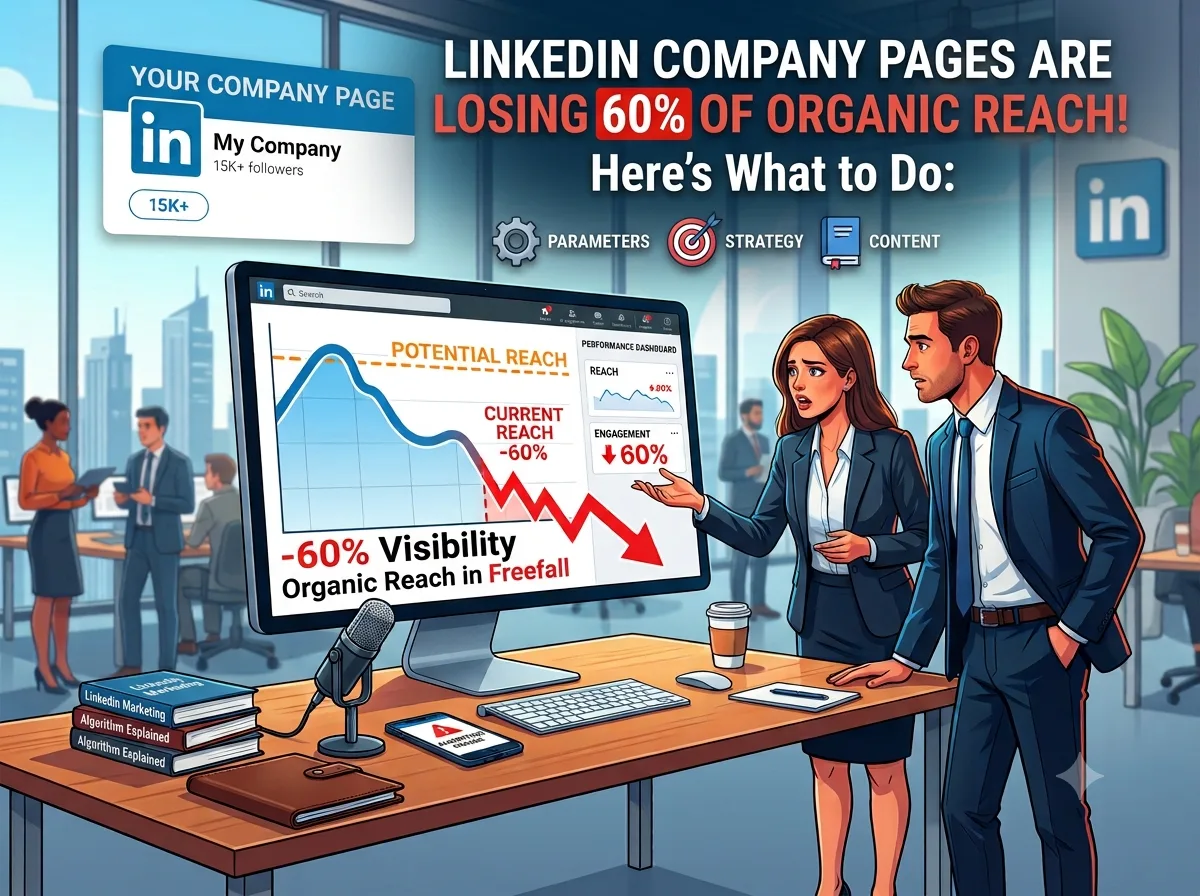
LinkedIn company pages and organic reach : the two are directly linked, and 2026 data shows a major shift businesses must address. LinkedIn company pages have lost between 60 and 66% of their organic reach since 2024. This isn’t a glitch, it’s a deliberate platform shift. Here’s what it means for independent businesses and how to adapt right now.
In this article:
- The observation: LinkedIn has changed the rules
- Why it matters for independent businesses
- 3 concrete actions to implement this week
- Our take at BMAX
- What to do now
- Should you abandon your page, and what to do instead: your questions
- Rebuilding your LinkedIn company page organic reach in 2026
The observation: LinkedIn has changed the rules
Since early 2024, organic reach for LinkedIn company pages has dropped significantly. Multiple studies confirm a 60 to 66% decline for company pages and a 50% drop for personal profiles. Nearly 98% of accounts have experienced a measurable fall.
In practical terms: a post that reached 10,000 people in 2024 now reaches only around 4,000, with the same number of followers.
LinkedIn has officially moved from a broad distribution model to a targeted distribution model. The platform now shows content to people most likely to engage meaningfully, comments, shares, replies, rather than pushing it to all followers by default.
Why it matters for independent businesses
For hospitality operators, tourism professionals, and local service businesses, LinkedIn is often the primary B2B channel. It’s where you build credibility, showcase projects, and attract partners or clients.
If your entire LinkedIn strategy runs through a company page, you’ve quietly lost two-thirds of your audience without realising it.
The good news: personal profiles are holding up better. A founder or team member publishing in their own name can reach an audience 2 to 3 times larger than the company page for equivalent content. Overall LinkedIn engagement actually grew by 8% in 2026, reaching an average of 5.20%.
LinkedIn isn’t dying, it’s just running on different logic now.
3 concrete actions to implement this week
1. Activate personal profiles in your team. Encourage founders, sales leads, or visible team members to publish under their own names. This is employee advocacy. The company page becomes an amplification tool, not the main voice.
2. Prioritise comments over likes. The LinkedIn algorithm gives comments 15 times more weight than a like. Ask open questions, spark genuine debate, and reply to every comment. These conversations generate organic reach that no posting frequency can match.
3. Choose depth over volume. Three posts per week with thin content achieves nothing in 2026. One well-crafted post rooted in genuine expertise, a project debrief, a lesson learned, a behind-the-scenes look, outperforms ten generic updates every time.
Our take at BMAX
BMAX is a French digital and audiovisual agency based in Provence. We work with independent hospitality and tourism businesses across the South of France, and we’re seeing this LinkedIn shift play out in real time with our clients.
The instinct when reach drops is to post more or spend on ads. That’s rarely the right move. What’s usually missing is a consistent content strategy built around recognisable people, not a logo.
A company page doesn’t have a voice. People do. LinkedIn knows this, and its algorithm now says it clearly.
Sources:
Ordinal, LinkedIn Company Page Reach 2026
LeBoard, Is LinkedIn Dead in 2026?
Brioude Internet, LinkedIn Algorithm Guide
Want to build a coherent LinkedIn strategy for your business? Let’s talk for 30 minutes, free and no commitment.
What to do now
LinkedIn company pages and organic reach are still connected, but the relationship has fundamentally changed. Brands that treat their company page as a broadcast channel will keep losing ground. Those that shift toward expert-led content, employee advocacy, and consistent publishing will adapt and grow. The algorithm rewards quality and consistency above all else. If your company page reach has dropped, it is not a sign that LinkedIn no longer works, it is a signal to change the way you use it. BMAX helps local businesses build a LinkedIn content strategy that fits their team and their goals.
Should you abandon your page, and what to do instead: your questions
Should you abandon your LinkedIn company page?
No. The page remains essential as a credibility showcase: prospects, candidates and partners check it before reaching out. What has changed is its role. It is no longer a reach engine, it is a landing point.
Why did LinkedIn cut company page reach?
It is not a bug but a deliberate choice. LinkedIn moved from broad broadcasting to targeted distribution: the platform now shows content to the people most likely to interact meaningfully, through comments and shares, rather than to every follower.
Which channel should you use instead?
The personal profiles of founders and employees, which lost roughly half as much reach as pages. A post published from the founder’s account and relayed by the team now reaches far more people than the same content posted from the company page.
How long does it take to rebuild visibility?
Expect three to six months of consistent publishing. The algorithm assesses steadiness and interaction quality over time: a one-off spike in activity will not reverse the trend.
Rebuilding your LinkedIn company page organic reach in 2026
LinkedIn company page organic reach is not dead, it is distributed differently. Pages that publish consistently and focus on educational content still reach thousands without paid promotion. BMAX builds LinkedIn strategies for SMEs that generate real organic reach.